

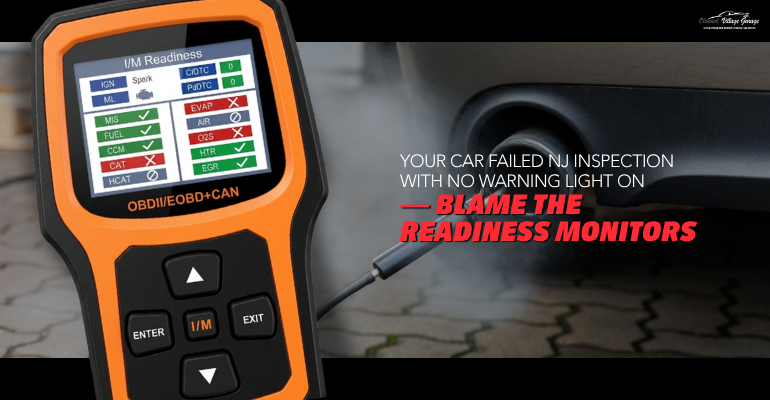
Your Car Failed NJ Inspection With No Warning Light On — Blame the Readiness Monitors
No check engine light. No warning message. The inspector hands you a rejection anyway, and the reason printed on the slip is something about monitors not ready.
This is the most avoidable failure in New Jersey inspection, and it usually happens to people who did something sensible — replaced a battery, had a code cleared, let the car sit for a month. Since New Jersey checks emissions rather than brakes and steering on passenger cars, the entire test happens through the diagnostic port, and an unfinished self-test is an automatic reject in Oldwick and everywhere else in Hunterdon County.
Quick Summary: Key Takeaways
- New Jersey tests emissions, not brakes: The passenger-car inspection is a computer check, so everything hinges on what the car reports.
- Monitors must be complete: The inspection rejects a car whose self-tests have not finished, even with zero faults stored.
- A battery disconnect resets them: Losing power wipes the monitor status the same way clearing codes does.
- Drive cycles are specific: Monitors need certain speeds, loads and temperatures, not just miles. The evaporative test is the slowest.
- Two years between tests: Most vehicles are inspected every two years, so a rejection is worth avoiding rather than repeating.
What a Readiness Monitor Is and Why the Inspector Cares
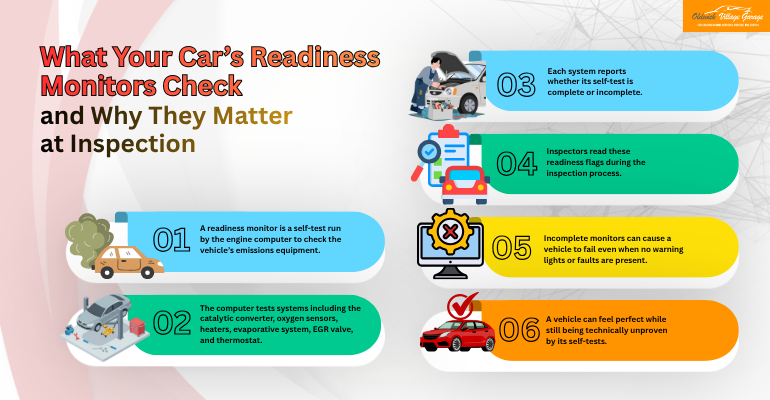
Your car grades its own emissions equipment. A modern engine computer runs a series of self-tests — on the catalytic converter, the oxygen sensors and their heaters, the evaporative system, the EGR valve, the thermostat — and each one reports back as complete or incomplete.
The inspection lane reads those flags. A vehicle with faults set fails for the faults; a vehicle with no faults but incomplete monitors fails because the computer has not yet proven the systems work.
That second case blindsides people. The car feels perfect and it is, technically, unproven. Absence of a warning light is not the same as a passing self-test.
The Things That Reset Your Monitors Without Warning You
Anything that cuts power to the engine computer clears the monitor status. Replacing a battery does it. So does a dead battery, a jump start gone wrong, a loose terminal, or a shop clearing codes after a repair.
Repairs are the common one. A perfectly good fix — a new coil, a sensor, an intake gasket — ends with the technician clearing the fault, and the car leaves with a clean dash and an empty scorecard. Clean is not the same as ready.
Long storage counts too. An Audi or Porsche that sat all summer under a cover comes back with monitors that never had the drive conditions they needed to run.
A Drive Cycle Is Not Just Driving Around for a While
Mileage alone does not do it. Each monitor waits for a specific set of conditions before it runs — a cold start below a certain coolant temperature, a stretch of steady cruise in a particular speed band, a deceleration with the throttle closed, a fuel level that is neither near full nor near empty.
The catalyst and evaporative monitors are the difficult pair. Evaporative testing on many European cars wants an ambient temperature range, a fuel level between roughly a quarter and three-quarters, and a long soak with the engine off, which is why a week of short commutes gets you nowhere.
Our roads here happen to help. A run out Route 78 with a steady cruise, then Old Turnpike Road at lower speed, then a proper overnight cold soak covers most of what a European car is looking for.
How to Check Your Own Status Before You Waste a Trip
Readiness is readable. Any shop with a scan tool can pull the monitor status in two minutes and tell you which tests are complete and which are still pending, and that answer costs nothing compared with a failed inspection and a return visit.
We do this as a pre-check. If everything reads complete, go get your sticker. If the evaporative monitor is still pending, we tell you what kind of driving finishes it and roughly how long to expect.
Timing helps. New Jersey lets you complete the inspection up to two months before the expiration date, with most vehicles due every two years and new vehicles on a five-year cycle, so there is room to check first and go second.
When the Rejection Is a Real Fault, Not Just a Pending Test
Sometimes the monitors are complete and the news is worse. A stored catalyst efficiency code, a small evaporative leak, an oxygen sensor that has drifted lean — those are genuine repairs, and they are what an emissions repair facility exists to sort out.
The order matters. Fix the cause, verify the repair with live data, then complete the drive cycle and confirm the monitors before you go anywhere near the inspection lane.
Skipping verification is how cars fail twice. We would rather hold the car an extra day than send you back for a second rejection.
Oldwick Drivers Have the Advantage of a Shop Open Seven Days
Timing an inspection around a work week is the annoying part. We are at 30 Old Turnpike Road in Oldwick, open seven days, from 5:30 in the morning on weekdays — which means a pre-inspection scan can happen before the office does.
We handle Audi, BMW, Jaguar, Land Rover, Mercedes, MINI, Porsche, Volkswagen, Volvo and exotics, and we are a licensed New Jersey emissions repair facility, so the diagnosis and the repair happen in one place.
Owners come to us from Bridgewater, Bernardsville, Basking Ridge and Washington Township. Get the scan before the sticker expires, not after the rejection.
Frequently Asked Questions
Q: Why did my car fail NJ inspection with no check engine light?
A: Almost certainly incomplete readiness monitors. New Jersey’s passenger-car test reads your engine computer, and a vehicle whose emissions self-tests have not finished running gets rejected even with no faults stored. The usual cause is a recent battery replacement or a cleared code.
Q: How long does it take to reset readiness monitors after a battery change?
A: It depends on how you drive, not just how far. Some monitors complete in a day of mixed driving; the evaporative and catalyst monitors often need several cold starts, steady highway cruising and overnight soaks, so plan on anywhere from a few days to two weeks.
Q: Does New Jersey inspect brakes and steering?
A: Not on standard passenger vehicles. New Jersey’s inspection for those vehicles is an emissions and on-board diagnostic check rather than a mechanical safety inspection, which is why the outcome depends entirely on what the car’s computer reports.
Q: Can I check my readiness monitors myself before inspection?
A: Yes, with a scan tool that displays I/M readiness status, or by having a shop pull it for you. It takes a couple of minutes and it tells you whether you are wasting a trip to the inspection station.
Get a Pre-Inspection Scan Before You Sit in the Lane
Two minutes with a scan tool beats a rejection slip and a second trip. Bring the car by and we will read the monitor status, explain what is pending, and fix anything that turns out to be real.
Oldwick Village Garage — 30 Old Turnpike Rd, Oldwick, NJ 08858
Hours: Mon-Fri 5:30 AM-7:30 PM; Sat 7:30 AM-7:00 PM; Sun 8:30 AM-7:00 PM — open seven days
Website: oldwickvillagegarage.com