

Why Is My Jaguar Jerking When It Shifts? Understanding Automatic Transmission Problems
Jaguar has built its reputation on refinement — smooth acceleration, effortless power delivery, and a ride quality that sets it apart from competitors. That’s why any jerking, lurching, or hesitation during gear changes feels so out of character and immediately noticeable. Automatic transmission jerking in a Jaguar is one of the most common drivability complaints we see at Oldwick Village Garage, and it’s rarely caused by a single obvious failure. More often, it’s the result of several interrelated issues — fluid condition, solenoid wear, calibration drift, or software — that compound over time. Understanding what causes Jaguar automatic transmission jerking puts you in a better position to address it before it becomes a costly repair.
How Jaguar Automatic Transmissions Work
Most modern Jaguars use a ZF automatic transmission — often the ZF 8HP eight-speed unit found in XE, XF, F-Pace, and F-Type models — which pairs with the engine management system to deliver rapid, smooth gear changes. These transmissions use hydraulically actuated clutch packs and bands controlled by electronic solenoids, all managed by a Transmission Control Module (TCM) that continuously adapts shift points and pressure based on driving conditions. The system is capable of delivering imperceptible shifts under normal conditions, but it operates within tight fluid pressure and temperature tolerances. Any deviation from those tolerances — whether from degraded fluid, a worn solenoid, an adaptive calibration issue, or sensor input errors — can interrupt the smooth hydraulic handoff between gear changes and produce the jerking sensation drivers report.
Common Causes of Shifting Jerks in Jaguar Automatics
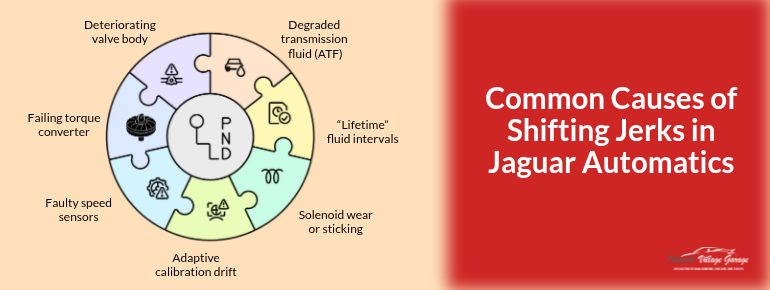
Several failure modes can produce transmission jerking in Jaguar vehicles. Degraded transmission fluid is one of the most common and preventable causes, as ATF breaks down, it loses its viscosity and hydraulic properties, causing pressure fluctuations that disrupt smooth clutch engagement. ZF transmissions are particularly sensitive to fluid condition, and Jaguar intervals that specify “lifetime” fluid are often too conservative for real-world driving. Solenoid wear or sticking is another frequent culprit — worn solenoids don’t modulate clutch pressure accurately, leading to abrupt engagement. Adaptive calibration drift occurs when the TCM’s learned shift patterns drift out of the optimal range, producing rough shifts that a TCM reset and recalibration can sometimes resolve. Faulty speed sensors, a failing torque converter, or a deteriorating valve body can also produce similar symptoms and require professional diagnosis to isolate.
How We Diagnose the Problem at Oldwick Village Garage
Proper diagnosis of Jaguar transmission jerking starts with a scan of the TCM for stored fault codes and a review of live transmission data, including line pressure, solenoid duty cycles, and fluid temperature. Our technicians use Jaguar-compatible diagnostic software to access the TCM’s full dataset, not just generic OBD-II codes. We also perform a fluid condition assessment — dark, burnt-smelling ATF is a clear indicator that the fluid has degraded and is contributing to the problem. Depending on findings, the solution may involve a fluid and filter service, a TCM recalibration and adaptive reset, solenoid replacement, or in more advanced cases, a valve body or torque converter repair. Our expert Jaguar mechanics in Oldwick, NJ, always diagnose before recommending a repair to ensure we’re solving the right problem.
Repair and Ongoing Maintenance for Your Jaguar
At Oldwick Village Garage, we recommend a proactive approach to Jaguar transmission maintenance. We offer a wide range of auto services, including scheduled maintenance for Jaguar vehicles. Changing ZF 8HP transmission fluid — contrary to what the “lifetime” designation implies — at 50,000–60,000 mile intervals significantly extends solenoid and valve body life and prevents the pressure-related issues that lead to jerking. If your Jaguar is already showing shift quality issues, a fluid service combined with a TCM adaptive reset often resolves them without further repairs needed. We source high-quality ATF that meets ZF’s specifications for these transmissions and perform all work in-house.
Schedule Your Jaguar Transmission Inspection Near Tewksbury
Rough shifting in your Jaguar won’t get better on its own. At Oldwick Village Garage near Tewksbury, our European car specialists will diagnose and resolve your transmission concern with the right tools and expertise. Call us at (908) 439-2236 or visit us at 30 Old Turnpike Road, Oldwick, NJ 08858 to schedule your appointment today.
Frequently Asked Questions
Q: Is it safe to drive my Jaguar if it’s jerking during shifts?
A: Short trips are generally manageable, but continued operation with transmission issues can accelerate clutch wear and potentially cause further damage. Get it inspected soon.
Q: Can a transmission software update fix shifting issues in my Jaguar?
A: Yes — in some cases Jaguar TSBs address adaptive calibration issues with software updates. Our diagnostic process checks for these before recommending mechanical repairs.
Q: How often should I change the transmission fluid in my Jaguar?
A: Despite “lifetime” designations, we recommend ZF transmission fluid service every 50,000–60,000 miles for real-world driving conditions to maintain smooth shift quality.
Q: What is a TCM adaptive reset and will it fix my Jaguar’s shifting?
A: An adaptive reset clears the TCM’s learned shift patterns, allowing it to relearn from scratch. It can resolve shift quality issues caused by calibration drift, often at minimal cost.