

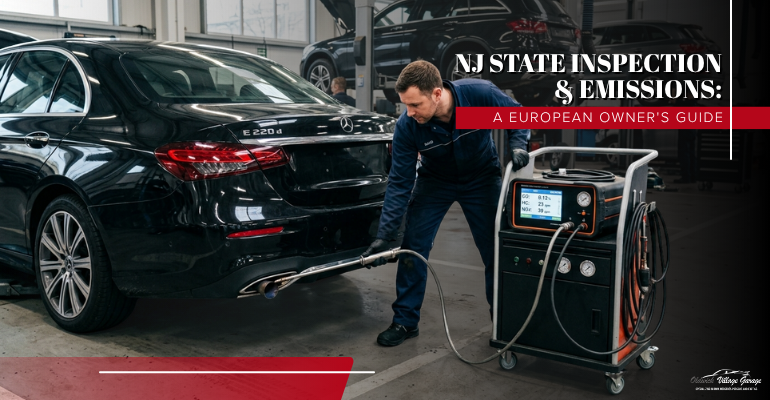
NJ State Inspection & Emissions: A European Owner’s Guide
Your inspection sticker expires next month. The check engine light came on back in July. A quick code clear feels like a fix, but the state reads your car’s readiness monitors, and a freshly wiped computer gets rejected before anyone opens the hood.
Oldwick Village Garage is a licensed New Jersey Inspection Station and Emissions Repair Facility, so Audi, BMW, Mercedes, MINI, Porsche, Volkswagen and Volvo owners across Hunterdon and Somerset counties can test and repair in one stop. Bring it early. Weekday doors open at 5:30 in the morning.
Quick Summary: Key Takeaways
- Emissions, not brakes: New Jersey dropped the safety portion for non-commercial passenger cars in 2010, so the test is an OBD-II scan.
- Two-year cycle: most passenger vehicles get inspected every two years, and a new car gets a five-year window before its first visit.
- Monitors decide it: clearing codes the week before the test causes a rejection, because the monitors need a full drive cycle to reset.
- Predictable euro failures: BMW N52 secondary air pumps, EA888 PCV valves on Audi and Volkswagen, and tired catalytic converters setting P0420.
- Tunes and deletes get caught: a Stage 1 map or a missing converter shows on the scan, however clean the tailpipe looks.
New Jersey inspects emissions, not brakes and ball joints
For a regular passenger car, the state test is an emissions test. New Jersey stopped checking safety items like wipers, horns and brakes on non-commercial vehicles back in 2010. An inspector plugs into the OBD-II port under the dash, reads the emissions monitors, confirms the malfunction indicator lamp is off, and checks that the car’s computer reports a finished self-test.
That’s the whole exam. Most passenger vehicles run on a two-year cycle, and a brand-new car gets roughly five years before its first trip through the lane. Diesel rules differ. Heavier diesel trucks and vans face an opacity test instead, which is a separate process from the gas-car scan.
Most European failures start with a stored code and a lit dash light
If the light is on, the car fails. No inspector passes a vehicle with the malfunction indicator lamp burning, even when it idles smooth and pulls hard. The second cause is quieter: monitors reading not ready after a battery swap or a code clear, because catalyst and EVAP monitors need dozens of miles of mixed driving before they set.
Pending faults count too. Converter codes that haven’t hardened into permanent faults still leave the readiness flag incomplete, and the scan tool reports exactly that. Diagnose first. Stickers come after.
A few German engines fail for the same reasons every year
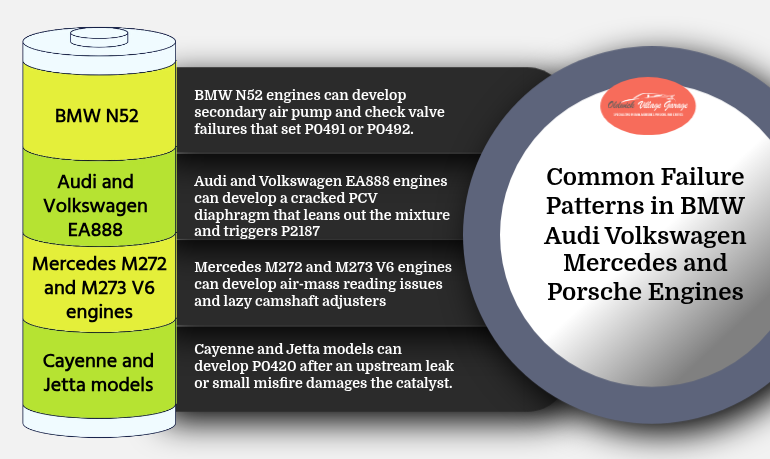
Patterns repeat. On BMW N52 sixes, the secondary air pump and its check valve rot out and set P0491 or P0492, usually after a decade of Jersey road salt. Audi and Volkswagen EA888 four-cylinders crack the PCV diaphragm on the valve cover, which leans out the mixture and lights P2187.
Mercedes M272 and M273 V6 engines drift on air-mass readings and lazy camshaft adjusters. Converters die last. By the time a Cayenne or a Jetta trips P0420, the real cause is often an upstream leak or a small misfire that cooked the catalyst months earlier.
Putting off a failed test costs more than the repair does
Fail, and you leave with a rejection notice and a deadline. New Jersey wants the repair and a retest, and driving on an expired sticker invites a ticket from any patrol car in Tewksbury that reads your plate.
A running emissions fault is also a fuel problem, since the EPA reports that a typical passenger vehicle emits about 4.6 metric tons of carbon dioxide a year, and an engine running rich or misfiring pushes that figure higher while it burns extra gas. You pay twice. Once at the pump, once at the retest.
Our prep catches the failure before the state does
We scan the car before it ever sees the lane. Pulling monitors and codes takes minutes and tells us whether the car is ready or two hundred miles short of ready. Factory-level tools handle the rest, so we read the same live data a dealer reads on a Porsche, a Mercedes, a BMW or an Audi, fuel trims included.
Then we drive it. Running a verification cycle after the repair proves the monitors set, which usually means one trip through inspection rather than three. Guessing is expensive.
Oldwick drivers get the early drop-off and a seven-day week
We sit on Old Turnpike Road in Oldwick, minutes from Interstate 78 at Exit 24. Greg runs the shop floor himself, so the person explaining the failure is the person who tested the car. No service writer stands between you and the answer.
Weekend hours matter here. Fail on Friday afternoon and the repair doesn’t have to wait until Monday morning, which is why drivers from Bridgewater, Bernardsville and Basking Ridge keep making the drive out past the farm fields.
Frequently Asked Questions
Q: Does New Jersey still do safety inspections?
A: Not for a regular passenger car. New Jersey ended the safety portion for non-commercial vehicles in 2010, so the test now reads emissions data through the OBD-II port. Commercial vehicles follow different rules.
Q: How often does a car need inspection in NJ?
A: Every two years for most passenger vehicles. Brand-new cars get roughly five years before a first inspection, and the month printed on the sticker sets your deadline.
Q: Will my BMW fail inspection with the check engine light on?
A: Yes. A lit malfunction indicator lamp is an automatic rejection, whatever the code turns out to be. Have it read, fix the cause, then test the car.
Q: Can you pass NJ inspection right after clearing codes?
A: Usually not. Clearing codes wipes the readiness monitors, and the scan reports them as incomplete. Catalyst and EVAP monitors often need dozens of miles of mixed city and highway driving before they finish.
Book inspection prep before the sticker runs out
Bring the car in, let us scan it, and find out what the inspection lane is going to see. Use the contact page to pick a day, and drop it before work if that suits you better.
Oldwick Village Garage — 30 Old Turnpike Rd, Oldwick, NJ 08858
Hours: Mon – Fri: 5:30 AM – 7:30 PM | Sat: 7:30 AM – 7:00 PM | Sun: 8:30 AM – 7:00 PM
Website: oldwickvillagegarage.com